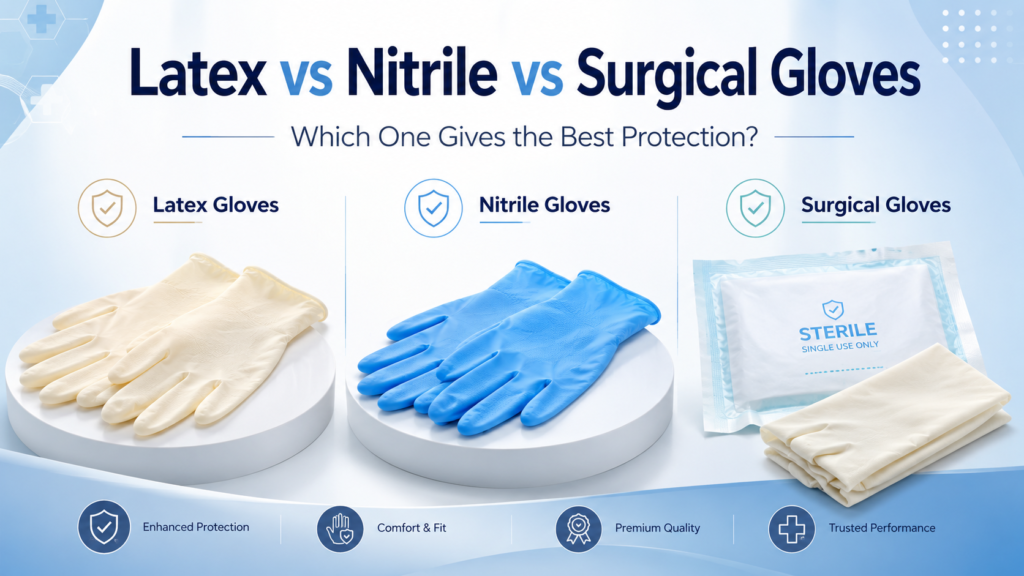
Latex vs Nitrile vs Surgical Gloves: What Is the Difference and Which One Should You Choose?
Choosing the right medical glove is not only about price. It is about safety, comfort, protection, hygiene, and the type of work being performed. For hospitals, clinics, laboratories, food handling businesses, manufacturers, and PPE distributors, the choice between latex gloves, nitrile gloves, and surgical gloves can directly affect user protection and customer satisfaction.
Many buyers compare these three glove types as if they are the same category, but there is one important point to understand first: latex and nitrile describe glove materials, while surgical describes a glove’s intended medical use and sterility level. In other words, a surgical glove can be made from latex or synthetic materials, while latex and nitrile gloves are commonly used for examination, industrial, food handling, and general protection purposes.
At Natalie Group Gloves, we supply high-quality latex, nitrile, and sterile surgical gloves for different industries and professional applications. Understanding the difference between these glove types will help you choose the most suitable product for your business, healthcare facility, or distribution market.
What Are Latex Gloves?
Latex gloves are made from natural rubber latex. They are known for their excellent elasticity, comfortable fit, and high tactile sensitivity. This means they stretch well, fit closely to the hand, and allow the user to feel objects clearly while working.
Latex gloves have been widely used in healthcare for many years because they provide a strong barrier against contamination while still allowing natural hand movement. They are often preferred in tasks that require precision, such as medical examinations, dental work, laboratory work, and general patient care.
One of the biggest advantages of latex gloves is comfort. The material is flexible and soft, which makes it easier to wear for longer periods. Latex gloves also provide good grip and dexterity, helping users perform detailed tasks without feeling restricted.
However, latex gloves may not be suitable for everyone. Some people are allergic or sensitive to natural rubber latex. Latex allergy can cause skin irritation or more serious allergic reactions in sensitive individuals. Because of this, many healthcare facilities and workplaces now use powder-free, low-protein latex gloves or choose latex-free alternatives such as nitrile gloves. CDC/NIOSH recommends non-latex gloves for some situations and reduced-protein, powder-free gloves when latex gloves are selected for infectious-material tasks.
Best Uses for Latex Gloves
Latex gloves are suitable for many professional environments where comfort, flexibility, and touch sensitivity are important. They are commonly used in medical examinations, dental clinics, laboratories, cleaning, beauty services, and light industrial work.
They are especially useful when the wearer needs strong hand movement and a close fit. For example, doctors, nurses, dentists, and lab technicians may prefer latex gloves because they feel natural on the hand and allow precise control.
Latex gloves are a strong choice when there is no latex allergy concern and when the task does not involve chemicals that require stronger chemical resistance.
What Are Nitrile Gloves?
Nitrile gloves are made from synthetic rubber, usually nitrile butadiene rubber. They are latex-free, making them a preferred choice for users who are allergic or sensitive to natural rubber latex.
Nitrile gloves are known for their strong puncture resistance, durability, and chemical resistance. This makes them popular across healthcare, food processing, automotive, manufacturing, cleaning, laboratories, and industrial environments. Natalie Group’s nitrile examination gloves page also highlights nitrile as latex-free, durable, powder-free, suitable for multiple industries, and available in different sizes, colors, and thicknesses.
Compared with latex gloves, nitrile gloves are generally stronger against punctures and tears. They also perform well when users handle oils, greases, acids, alcohols, and many chemical substances. OSHA-related glove selection guidance notes that nitrile gloves are used for jobs requiring dexterity and sensitivity and can stand up to heavy use, including exposure to oils, greases, acids, caustics, and alcohols.
Another advantage of nitrile gloves is their versatility. They are widely used in medical and non-medical industries because they offer a balance of protection, comfort, and allergy safety. Modern nitrile gloves are also thinner and more comfortable than older versions, giving users better touch sensitivity while maintaining strong protection.
Best Uses for Nitrile Gloves
Nitrile gloves are ideal for environments where durability, puncture resistance, and latex-free protection are important. They are commonly used in hospitals, clinics, laboratories, food handling, cleaning, automotive work, industrial work, and chemical handling.
They are especially useful when a company wants one glove type that can serve many departments. For example, a distributor supplying gloves to healthcare, food service, and manufacturing clients may choose nitrile gloves because they are suitable for a wide range of applications.
Nitrile gloves are also a smart choice for workplaces that want to reduce the risk of latex allergy among staff, customers, or patients.
What Are Surgical Gloves?
Surgical gloves are medical gloves designed for surgical procedures and sterile environments. Unlike regular examination gloves, surgical gloves are sterile, carefully packed, and usually anatomically shaped for the left and right hand. They are made for high precision, strong barrier protection, and comfort during long procedures.
The key difference is not only the material. The biggest difference is the purpose. Surgical gloves are made for operations, invasive medical procedures, and situations where sterility is critical. Examination gloves are usually used for general patient care, medical checks, and routine protection, while surgical gloves are designed for higher-risk clinical environments.
The FDA describes medical gloves as PPE used to protect wearers and patients from microorganisms during medical procedures and examinations. It also lists examination gloves and surgical gloves as types of disposable medical gloves.
Surgical gloves may be made from latex or synthetic materials. Latex surgical gloves are known for excellent comfort and sensitivity, while synthetic surgical gloves may be preferred when latex allergy is a concern. The correct choice depends on the procedure, user preference, hospital policy, and patient safety requirements.
Best Uses for Surgical Gloves
Surgical gloves are best for operating rooms, surgical procedures, sterile medical procedures, and high-risk healthcare environments. They are used by surgeons, operating room nurses, and other medical professionals who need sterile protection and precise hand movement.
They are not usually required for general food handling, basic cleaning, or standard industrial work. For those applications, examination gloves such as nitrile or latex gloves are usually more practical and cost-effective.
If your business supplies hospitals, clinics, or surgical centers, sterile surgical gloves are an essential product category because they meet a different need from standard disposable examination gloves.
Latex vs Nitrile Gloves: Main Differences
The main difference between latex and nitrile gloves is the material. Latex gloves are made from natural rubber latex, while nitrile gloves are made from synthetic rubber.
Latex gloves are usually chosen for comfort, flexibility, and touch sensitivity. They feel natural on the hand and are excellent for tasks requiring fine movement. However, they may cause allergic reactions in users who are sensitive to latex.
Nitrile gloves are chosen for latex-free protection, durability, and resistance to punctures and many chemicals. They are suitable for users with latex allergies and are often preferred in healthcare, laboratories, food handling, automotive, and industrial environments.
In simple terms, choose latex gloves when comfort and sensitivity are the main priority and there is no allergy concern. Choose nitrile gloves when allergy safety, puncture resistance, and wider chemical protection are more important.
Latex vs Surgical Gloves: Main Differences
Latex gloves refer to the material, while surgical gloves refer to the use. A latex glove can be an examination glove or a surgical glove, depending on how it is manufactured, tested, sterilized, and packed.
Latex examination gloves are usually used for general medical checks, patient care, dental work, and laboratory tasks. Latex surgical gloves are sterile and designed for surgery or invasive procedures.
So, the question is not simply “latex or surgical?” The better question is: “Do I need a non-sterile examination glove or a sterile surgical glove?” If the task is a routine examination, latex examination gloves may be suitable. If the task is surgery, sterile surgical gloves are required.
Nitrile vs Surgical Gloves: Main Differences
Nitrile gloves are often used as examination gloves, but surgical gloves can also be made from synthetic materials. The difference again comes down to intended use, sterility, and performance requirements.
Nitrile examination gloves are ideal for general protection, especially where latex-free gloves are needed. They are strong, durable, and suitable for many industries.
Surgical gloves are specifically designed for sterile medical procedures. They usually provide a more precise fit and are packaged to maintain sterility until use. If a task involves surgery or invasive medical procedures, surgical gloves are the correct choice. If the task involves general examination, food handling, laboratory work, or industrial protection, nitrile examination gloves may be more suitable.
Powder-Free Gloves: Why They Matter
Today, many buyers prefer powder-free gloves because they reduce powder-related contamination and irritation risks. Powder was historically used to make gloves easier to put on, but modern glove technology now allows easy donning without powder.
The FDA published a final rule banning powdered surgeon’s gloves, powdered patient examination gloves, and absorbable powder for lubricating surgeon’s gloves due to health risks from exposure.
For healthcare and professional use, powder-free gloves are now widely preferred because they support cleaner handling, reduce residue, and are more suitable for sensitive environments.
Quick Comparison Table
| Feature | Latex Gloves | Nitrile Gloves | Surgical Gloves |
|---|---|---|---|
| Main meaning | Material type | Material type | Use/type of medical glove |
| Material | Natural rubber latex | Synthetic rubber | Latex or synthetic |
| Allergy concern | Possible latex allergy | Latex-free | Depends on material |
| Comfort | Excellent | Very good | Excellent precision fit |
| Puncture resistance | Good | Very strong | High, depending on material |
| Chemical resistance | Moderate | Stronger for many uses | Depends on material |
| Sterile? | Usually non-sterile unless specified | Usually non-sterile unless specified | Yes, sterile |
| Best for | Medical exams, dental, lab, general use | Healthcare, food, lab, industrial | Surgery and sterile procedures |
Which Glove Should You Choose?
Choose latex gloves if you need excellent comfort, elasticity, and touch sensitivity, and there is no concern about latex allergy.
Choose nitrile gloves if you need latex-free protection, stronger puncture resistance, and a glove suitable for healthcare, food handling, laboratories, cleaning, automotive, and industrial work.
Choose surgical gloves if you need sterile gloves for surgery, operating rooms, or invasive medical procedures. Surgical gloves are not simply “stronger examination gloves”; they are designed for a specific sterile medical purpose.
For distributors and bulk buyers, the best approach is often to stock more than one type. Latex gloves can serve users who prioritize comfort and fit. Nitrile gloves can serve users who need latex-free, durable, multi-purpose protection. Surgical gloves can serve hospitals and medical centers that require sterile procedure gloves.
Why Choose Natalie Group Gloves?
Natalie Group Gloves supplies latex, nitrile, and sterile surgical medical gloves for healthcare, food service, manufacturing, and other industries. The company’s website emphasizes quality, innovation, sustainability, and ethical business practices, with product categories including latex examination gloves, nitrile examination gloves, and sterile surgical gloves.
Whether you are a hospital, clinic, PPE distributor, food handling business, laboratory, or industrial supplier, choosing the right glove type helps protect users, improve hygiene, and support safer operations.
If you are unsure which glove is best for your market, Natalie Group Gloves can help you compare materials, sizes, packaging, and product specifications so you can make the right purchasing decision.
Final Thoughts
Latex, nitrile, and surgical gloves each serve an important purpose. Latex gloves are known for comfort and flexibility. Nitrile gloves are known for latex-free durability and strong protection. Surgical gloves are designed for sterile medical procedures where precision and safety are critical.
The right glove depends on the work environment, allergy concerns, protection level, and whether sterility is required. By understanding these differences, buyers can make better decisions and choose gloves that match the needs of healthcare professionals, workers, patients, and customers.
For high-quality latex gloves, nitrile gloves, and sterile surgical gloves from Malaysia, Natalie Group Gloves is ready to support your business with reliable products and professional supply solutions.